I'm a coffee person, I usually start the day with an Americano or three.
For a couple years I've made do with one of Krups' $60 espresso makers. Design-wise it's a disaster: the On light is dim, the basket usually falls out when being emptied, the lid can't be removed from the carafe, and a rubber foot went missing. But its only waste product are the grounds that go into the kitchen compost.
Which is an order of magnitude better than the rampant 'coffee pods' craze featured in yesterday's Seattle Times.
Showing posts with label Pollution. Show all posts
Showing posts with label Pollution. Show all posts
Monday, February 17, 2014

Monday, October 28, 2013
Monday, June 4, 2012
June is Orca Awareness Month

Wednesday, February 1, 2012
Ignoring stormwater science
Does anyone doubt that stormwater pollutes Western Washington's water cycle? At its simplest, civilization drops stuff on the ground, and gravity washes it downhill into Puget Sound.
Pretty easy. Yet now comes Democratic State Rep. Larry Springer of Kirkland. His HB2641 proposes making laboriously negotiated low-impact development rules voluntary.
Wednesday, January 25, 2012
An example on your fingertips
The news that most thermal cash register receipt paper is coated with bisphenol-A receives such little notice, that when a tiny syndicated column mentioning it did surface last Sunday, I realized I had forgotten it since it had first come out over a year ago:
Thursday, January 12, 2012
Just the highlights
There are a number of items competing for the top of the environmental news -- some positive, some worrisome. Here they are, with pointers:
State of Washington puts Puget Sound on 'waters of concern' list. In a report to the EPA, the state Department of Ecology cites the threat of ocean acidification to sea life. Oceans naturally absorb CO2, but mankind's CO2 output has the oceans working overtime. Too much CO2 lowers ocean pH, interfering with the food chain by altering the development of key species.
Property wrongs. On Monday the U.S. Supreme Court
Friday, September 23, 2011
One word: Microplastics
More evidence for people still not convinced that our plastics get into the oceans:
American researchers study microplastic debris in Clayoquot
By Yasmin Aboelsaud, Special to the Westerly News September 22, 2011
University of Washington Tacoma researchers collecting microplastic debris in Clayoqout Sound found more polystyrene in the surface of the water compared to areas in Puget Sound, Washington.
...
Friday, September 16, 2011
Think before spraying
Even in environmentally-conscious Seattle, there are still chances to witness bonehead moves. My turn came today while passing by this block near Carkeek Park:
View Larger Map
View Larger Map
Thursday, January 13, 2011
New oil spill bill looks stronger
Representatives Christine Rolfes and Zack Hudgins are the lead sponsors of HB1186, a bill now in the news that would improve preparations to respond to oil spills in Puget Sound. The roundup:
- Morning News Tribune, Jan. 12
- Joel Connelly, Seattle P-I Jan. 12
- AP video- Presidential panel's report "rekindles push for reform," Jan. 11
Friday, February 5, 2010
Malevolent energy cloud-beings praise Puget Sound cleanup report
"Glass half-full. Of poison"
A new state report on the health of Puget Sound is eliciting praise from a local environmental advocacy group.
"Decline of Puget Sound good for Zan-Tor and other malevolent energy cloud-beings," said Zan-Tor, spokesbeing for the Seattle Environment, Water & Effluent Resources Coalition (SEWER Coalition).
A new state report on the health of Puget Sound is eliciting praise from a local environmental advocacy group.
"Decline of Puget Sound good for Zan-Tor and other malevolent energy cloud-beings," said Zan-Tor, spokesbeing for the Seattle Environment, Water & Effluent Resources Coalition (SEWER Coalition).
Monday, August 24, 2009
Puget Sound tribes work to cleanup derelict fishing gear
Derelict fishing gear refers to lost and abandoned nets and traps that create hazards for marine-dependent life. The effort involves local conservation groups and Native American tribes, and is now getting federal stimulus funds. William Yardley's article is in today's New York Times.
Tuesday, July 28, 2009
Seattle disposal bag fee - Aug. 18 Referendum
Seattle's 20-cent per bag fee on paper and plastic must get past an August 18 ballot measure. The run-up to the vote pits environmentalists versus an out of town, chemical industry-funded campaign.
Correction Although the referendum was submitted by fee opponents, a Yes vote will let the fee stand.
To avoid the fee, shoppers need only bring their own bags when they shop.
Correction Although the referendum was submitted by fee opponents, a Yes vote will let the fee stand.
To avoid the fee, shoppers need only bring their own bags when they shop.
Friday, June 19, 2009
Clean Water Restoration Act goes to full Senate
On a 12-7 vote, the Environment and Public Works Committee on Thursday approved a version of the Clean Water Restoration Act, S. 787. If it becomes law, one of the more useful changes is the clarification of the federal government's regulatory jurisdiction, by replacing the term "navigable waters" with "waters of the United States." So-called 'property rights' activists have questioned the old language in order to attack protections for wetlands and small bodies of water.
In news relating to the non-wet part of the biosphere, the House Appropriations Committee approved an EPA funding bill that bars spending, from any legislation, that would make factory farms report greenhouse gas emissions as part of the Clean Air Act. Even though the rule would only apply to the biggest livestock operations, agri groups fear it could lead to EPA regulations or fees on methane from animals. Even though EPA says it has no plans to go that far.
In news relating to the non-wet part of the biosphere, the House Appropriations Committee approved an EPA funding bill that bars spending, from any legislation, that would make factory farms report greenhouse gas emissions as part of the Clean Air Act. Even though the rule would only apply to the biggest livestock operations, agri groups fear it could lead to EPA regulations or fees on methane from animals. Even though EPA says it has no plans to go that far.
Wednesday, April 15, 2009
Important marine conservation report coming to Frontline
"Poisoned Waters," a new documentary coming to PBS Frontline on April 21, looks at endangered Puget Sound and Chesapeake Bay more than 30 years after the passage of the Clean Water Act.
Excerpts
Hopefully this program will call attention to the main culprit: the polluters is us. The communities have short term economic interests in not cleaning up these important waterways, and we may have delayed just long enough to make the damage irreversible.
UPDATE (4/22): Did you catch the show? Watch it here!
Excerpts
Hopefully this program will call attention to the main culprit: the polluters is us. The communities have short term economic interests in not cleaning up these important waterways, and we may have delayed just long enough to make the damage irreversible.
UPDATE (4/22): Did you catch the show? Watch it here!
Friday, February 27, 2009
Tuesday, October 14, 2008
An opportunity for cleaner water AND walkability
A victory for Puget Sound environmentalists contains possibilities for far-reaching changes in controlling stormwater, one of the main sources of Puget Sound water pollution, as well as improving conditions for pedestrians in Seattle.
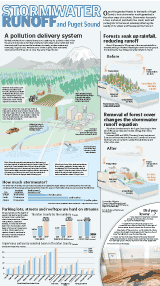
The victory is a recent ruling by Washington's Pollution Control Hearings Board, regarding a suit by environmentalists on the inadequacy of the National Pollutant Discharge Emission System. Among other things, NPDES regulates municipal and industrial stormwater discharges.
Washington is one of the states which has received federal permission to self-administer NPDES.
The victory is a recent ruling by Washington's Pollution Control Hearings Board, regarding a suit by environmentalists on the inadequacy of the National Pollutant Discharge Emission System. Among other things, NPDES regulates municipal and industrial stormwater discharges.
Washington is one of the states which has received federal permission to self-administer NPDES.
Thursday, August 28, 2008
Plastic oh no ban, industry says
Don't celebrate the Seattle 20¢ plastic bag fee/styrofoam ban just yet, canvassers are gathering signatures on a petition that would put a bag fee repeal on the November ballot.
Who could possibly want a repeal of the fee? Why, the plastics industry. Of course, they call it a tax:
Who could possibly want a repeal of the fee? Why, the plastics industry. Of course, they call it a tax:
Monday, July 28, 2008
Paper nor plastic? - Part Deux
The Seattle City Council today approved the measure imposing a 20 cent fee on plastic and paper shopping bags, to encourage the adoption of reusable bags. The council also passed a ban on use of foam containers by businesses that serve food.
The City will distribute reusable bags, and the per-bag fee will start in January 2009. Then the choice of whether to pay the fee is up to the individual shopper. As the next mayor of Seattle, Richard Conlin, says: "You only have to pay it if you choose not to use reusable bags."
The foam ban has three phases. This coming January, restaurants and the like will have to stop using polystyrene and styrofoam. Then a year after that, all other plastic containers and utensils must be replaced by biodegradables.
The City will distribute reusable bags, and the per-bag fee will start in January 2009. Then the choice of whether to pay the fee is up to the individual shopper. As the next mayor of Seattle, Richard Conlin, says: "You only have to pay it if you choose not to use reusable bags."
The foam ban has three phases. This coming January, restaurants and the like will have to stop using polystyrene and styrofoam. Then a year after that, all other plastic containers and utensils must be replaced by biodegradables.
Monday, July 14, 2008
Paper nor plastic?
Seattle debated whether the city may follow in the footsteps of San Francisco, on July 8 discussing a proposal for a 20 cent fee on all disposal shopping bags, as well as a long overdue ban on foam food containers. The meeting was called by the City Council's Environment, Emergency Management and Utilities Committee.
Those who attended the meeting (including The Bag Monster) heard from fellow citizens in overwhelming support of the ban, which if approved would go into effect in 2010. One provision of the ban is that each household in the city would receive a free reusable shopping bag.
Who opposes the fee? Professional curmudgeons and the grocery industry, who counterproposed a per-visit fee.
Those who attended the meeting (including The Bag Monster) heard from fellow citizens in overwhelming support of the ban, which if approved would go into effect in 2010. One provision of the ban is that each household in the city would receive a free reusable shopping bag.
Who opposes the fee? Professional curmudgeons and the grocery industry, who counterproposed a per-visit fee.
Monday, July 7, 2008
The good Puget Sound news
Lest anyone think Puget Sound environmental policy and water quality are going completely to hell, I am glad to report that a piece of good news happened last week. The Neah Bay rescue tug, which stands ready to assist oil tankers and other vessels transiting the can-be-stormy Strait of Juan de Fuca entrance to Puget Sound, returned to duty on July 1.
"The tug" is actually two boats that will split the assignment: the Hunter and the Gladiator, both under contract from Crowley Maritime.
What is notable is that this marks the first time the tug will be on duty for 12 continuous months. In past years state funding was only available for part of the year. As if oil spills check the calendar. This time the state legislature voted a full 12 months, but there is no guarantee for the following year.
"The tug" is actually two boats that will split the assignment: the Hunter and the Gladiator, both under contract from Crowley Maritime.
What is notable is that this marks the first time the tug will be on duty for 12 continuous months. In past years state funding was only available for part of the year. As if oil spills check the calendar. This time the state legislature voted a full 12 months, but there is no guarantee for the following year.
Subscribe to:
Posts (Atom)